
Cart is empty
Money Counters - Cash Handlin Equipment - Service & Support
29 Years of Service - Nationwide Sales & Support
Product Categories..
- Cash Handling Equipment
- Bill Counters & Money Counting Machines
- Canadian Bill Counters
- Mixed Bill Counters & Currency Discriminators
- Cash Coin Counting Scales
- Counterfeit Money Detectors
- Coin Counters & Coin Sorters
- Business & Office Printers
- Reliable External Displays
- Shop Money Counters
- Count & Coin Sorters
- Count Mixed Denominations
- Check Processing Machines
- Check Encoders (MICR Encoding Machines)
- Business Check Scanners
- Check Signing Machines
- Check Joggers
- Check Endorsers
- Office Machines
- Document Scanners
- High-Volume Production Scanners
- Deskside Paper Shredders
- Office Paper Shredders
- Commercial Paper Shredders
- Document Sequencing Machines
- Paginators & Numbering Machines
- Paper Jogging Machines
- Document Perforators
- MertoVac
- Mailing Machines
- Folder Inserters (Mail Inserting Machines)
- Paper Folding Machines
- Address & Envelope Printers
- Envelope Sealing Machines
- Pressure Seal Machines
- Automatic Envelope Openers
- Document Perforators
- High-Speed Paper Joggers
- Tabbing Machines
- Cut-Sheet Paper Cutters
- Document Bursting Machines
- Time Date Stamps
- Time Clocks & Time Recorders
- Time Stamp Machines
- Time Stamp Ribbons
- Time Stamp Accessories
- Embossers & Transcript Validators
- Digital Printing
- Digital Color Printers
- Cut-True Paper Cutters
- Business Card Cutters
- Creasing & Perforating Machines
- Booklet Makers & Finishers
- Document & Paper Joggers
- Automatic Document Folders
- Parts & Supplies
- Ink & Holders
- Air Duster
- Coin Counters Parts
- Shredder Oil
- Shredder Bags
- Light Bulbs
- Micr Ribbons
- Cleaning Cards
- Amrotec X-1 Parts
- Amrotec X1000 Parts
Check Encoders (MICR Encoding Machines)
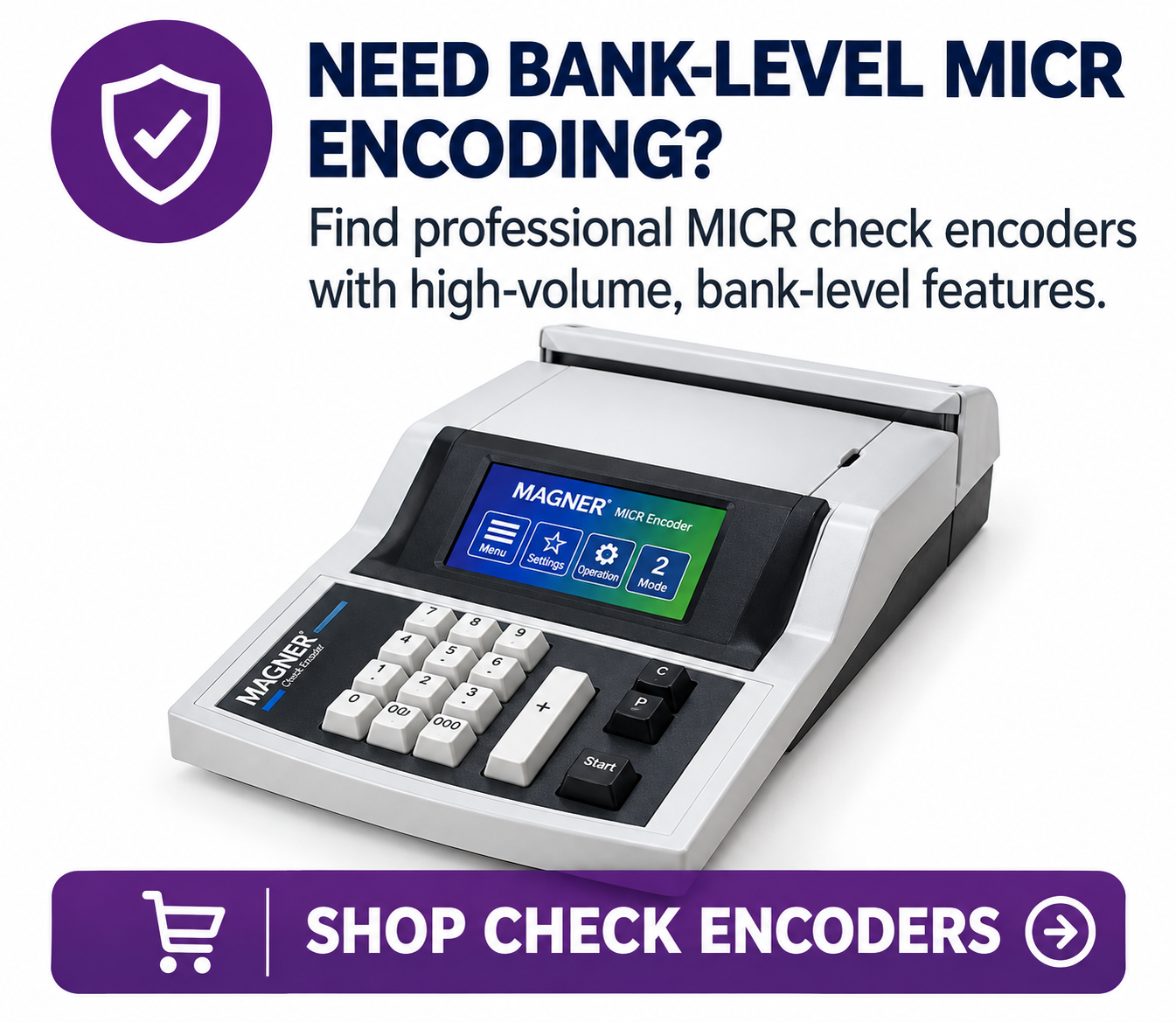
Secure your financial workflows and eliminate bank rejection fees with heavy-duty commercial check encoders designed for precise MICR printing, amount encoding, and seamless banking compliance.
Commercial Check Encoders: Secure & Compliant MICR Check Printing
Achieve absolute precision and seamless banking compliance. Check encoders perform the most critical function in paper-based financial transactions: printing machine-readable banking data that financial clearinghouses can process instantly. ACE Business Machines offers a premium line of commercial check encoder machines engineered to add crucial details—including routing numbers, account numbers, and check amounts—using industry-standard MICR (Magnetic Ink Character Recognition) technology.
Without proper MICR encoding, paper checks cannot be read by automated bank sorting systems. They must be intercepted and handled manually, leading to severe processing delays, steep bank rejection fees, and increased security risks. Investing in a professional check printing machine keeps your financial workflows fast, cost-effective, and fully compliant.
Key Features of Our Banking Check Encoders
Our advanced currency and document encoders are engineered to optimize your daily back-office workflows while providing ironclad financial security:
- Integrated MICR Technology: The core of banking compliance. The encoder applies a specialized magnetic ink character string required by automated clearinghouses for error-free digital reading.
- Precision Banking Data Printing: Errors in a routing or account number can halt a major transaction. Our machines guarantee absolute alignment and typeface precision when printing critical account details.
- Amount Encoding & Proofing: Many advanced models allow you to encode the exact monetary amount onto the bottom right of the check. This multi-step validation checks the printed amount against your ledger data to streamline the proofing process.
- Tamper-Proof Secure Check Printing: By automating the application of sensitive financial text and restricting physical access to the printing process, our encoders dramatically lower the risk of internal tampering and payment fraud.
Ideal Use Cases & Industry Applications
Our compliant check printing machines are indispensable tools for entities that manage high-volume or high-liability paper check operations:
- Banks & Financial Institutions: Utilized by branch tellers to print official cashier's checks, create money orders, or perform correction encoding (striping) on incoming checks with damaged or unreadable MICR lines.
- High-Volume Corporate Back-Offices: Companies that manage in-house payroll or accounts payable operations benefit from the speed, localized cost control, and added security of in-house secure check printing.
- Title, Real Estate & Escrow Firms: In environments where immediate finality and absolute accuracy on large-sum checks are non-negotiable, a dedicated encoder guarantees professional, auditable document integrity.
Frequently Asked Questions (FAQ)
1. What is the difference between a standard laser check printer and a check encoder? A standard laser printer prints the overall visual design of a check onto blank check stock using MICR toner. A check encoder is a highly specialized, dedicated desktop machine used to stamp or "encode" specific transaction-level data (most notably the exact dollar amount or banking corrections) onto the bottom of a check that has already been written, formatting it perfectly for automated high-speed bank scanners.
2. What is "MICR striping" or correction encoding? When a bank receives a check with a torn, smudged, or improperly printed routing number, automated sorting machines will reject it. Tellers use a check encoder to apply a clean "MICR stripe" (a correction paper strip or direct overprint) along the bottom edge of the damaged document, re-encoding the correct account digits so the check can continue through the automated clearing system without manual delay.
3. Why can't I just use regular printer ink for the check data? Standard inkjet and laser printer inks lack the magnetic properties required by commercial bank reader-sorters. Federal banking regulations require the routing and account characters to be printed using specialized magnetic ink or toner. If a check lacks this magnetic signature, it cannot be read by automated systems and will be flagged as non-compliant.
Tel: 818-548-7870 Email: Sales@acebminc.com
10276 Foothill Blvd. Lake View Terrace, CA 91342