Cart is empty



Product Categories..
- Commercial Bill Counters & Money Counting Machines
- Currency Discriminators (Multi-Denomination Counters)
- Coin & Cash Counting Scales
- Counterfeit Money Detectors
- Coin Counters & Coin Sorters
- Business & Office Printers
- Check Encoders (MICR Encoding Machines)
- Check Signing Machines
- Check Endorsers
- Check Scanners for Business
- Check Joggers
- Address & Envelope Printers
- Booklet Makers & Finishers
- Business Card Cutters
- Creasing & Perforating Machines
- Cut-Sheet Paper Cutters
- Cut-True Paper Cutters
- Deskside Paper Shredders
- Office Paper Shredders
- Commercial Paper Shredders
- Digital Color Printers
- Document Bursting Machines
- Paper Folding Machines
- Document & Paper Joggers
- Automatic Document Folders
- Reliable Document Perforators
- Document Scanners
- Document Sequencing Machines
- Embossers & Transcript Validators
- Automatic Envelope Openers
- Envelope Sealing Machines
- Folder Inserters (Mail Inserting Machines)
- Paper Jogging Machines
- Paginators & Numbering Machines
- Pressure Seal Machines
- High-Volume Production Scanners
- Tabbing Machines
- Time Clocks & Time Recorders
- Time Stamp Accessories
- Time Stamp Ribbons
- Time Stamp Machines
- Parts & Supplies
My account My account
Carnation CR1450 Compact Multi-Currency Discriminator for SMBs
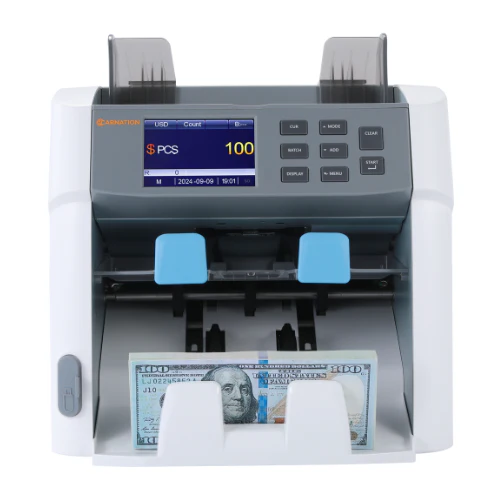
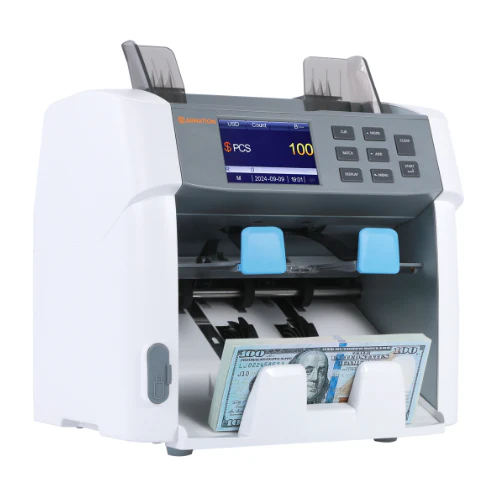
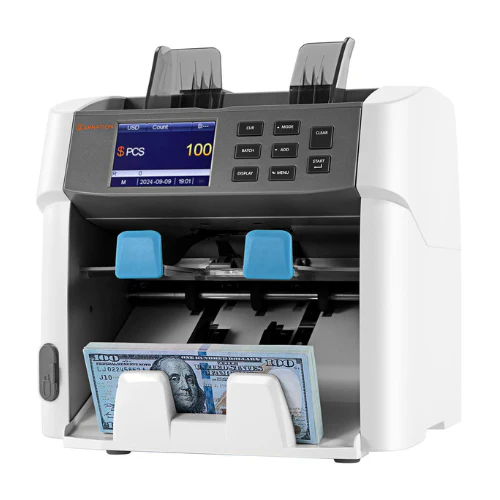


Carnation CR1450 – Compact 1.5 Pocket Currency Sorter & Discriminator
Carnation CR1450 is a powerful 1+1 pocket currency discriminator engineered for businesses demanding fast, reliable, and secure cash processing without the large footprint of a full-sized sorter. Designed to bring high-end functionality into any space, the CR1450 is the ideal solution for modern cash handling where speed, accuracy, and detailed tracking are paramount.
Why Choose the CR1450? Key Benefits
The CR1450 offers a significant upgrade over basic currency counters, maximizing efficiency through its professional sorting architecture:
- Exceptional "Non-Stop" Processing: Count at speeds up to 1,200 notes per minute with high-precision mixed denomination recognition. The 1+1 pocket design allows for continuous operation—diverting suspicious, unfit, or different denomination notes to the 50-note reject pocket without pausing the count.
- Ultimate 12-Point Security: Protect your business from financial loss with an advanced security suite, including Dual CIS (Contact Image Sensors), UV, MG, IR, and MT. This bank-grade system verifies the authenticity of every bill across multiple world currencies (USD, EUR, GBP, CAD, and more).
- Full Audit Traceability: Integrated Serial Number Recognition provides a detailed audit trail for every processed bill. This feature is critical for high-compliance industries like banking and cannabis retail.
- User-Friendly & Maintenance-Ready: A vibrant 3.5” LCD touchscreen ensures intuitive operation. The machine is designed for longevity, featuring easy-access top and rear panels for quick cleaning and instant jam removal.
Technical Specifications
| Feature | Detail |
| Model Type | 1.5 Pocket (1+1) Currency Discriminator |
| Counting Speed | Up to 1,200 Notes per Minute |
| Detection Suite | Dual CIS, UV, MG, IR, MT (12-Point Detection) |
| Hopper Capacity | 500 Notes |
| Reject Capacity | 50 Notes (Continuous Workflow) |
| Connectivity | USB, RS232, RJ11, LAN, Optional WiFi |
| Dimensions | 10.7” W × 10.4” L × 10.2” H |
| Warranty | 2-Year Comprehensive Warranty (Parts & Labor) |
Brands:
Carnation
No reviews found


1. What is the difference between a bill counter and a currency discriminator?
A standard bill counter is a "piece counter"—it tells you how many pieces of paper went through. A currency discriminator is a "value counter"—it uses digital eyes (CIS) to look at the bill, identify if it’s a $20 or a $100, and give you a total monetary value.
2. Is a currency discriminator better at catching fakes than a cheap counter?
Yes. Standard counters usually only check for magnetic ink or UV glow. Discriminators use Image Recognition, meaning they compare the actual artwork and security features of the bill against a high-resolution database. This is the only reliable way to catch "supernotes" or bleached bills (e.g., a $1 bill reprinted to look like a $100).
3. What does "1+1 Pocket" or "2-Pocket" mean?
This is one of the most searched terms.
- A 1-Pocket machine stops and beeps every time it finds a suspect or "unfit" bill.
- A 2-Pocket (1+1) machine has a separate Reject Pocket. It sends suspect bills to the top pocket while the main count continues without stopping. This is essential for high-volume environments.
4. Can currency discriminators count international money?
Most modern discriminators come with "Multi-Currency" modes. Because they rely on image scanning, they can be programmed to recognize the distinct designs of Euros, Canadian Dollars, British Pounds, and Mexican Pesos, often handling them all in the same stack.
5. Why is my discriminator giving a "CIS Error"?
This is usually a sign that the "eyes" of the machine are dirty. Cash is incredibly dusty; we recommend using cleaning cards or a microfiber cloth weekly to wipe the sensors. If the sensors are blocked by dust, the machine can't "see" the bill to identify it.